

.png)

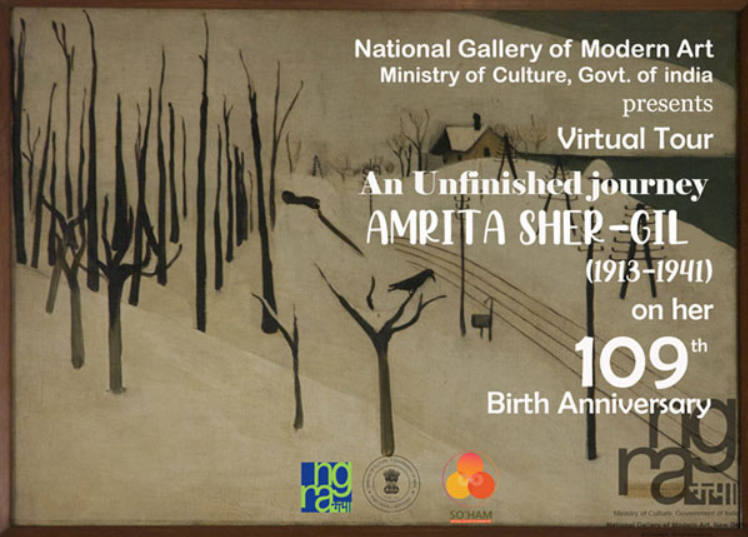
The Virtual Tour titled “An Unfinished Journey | Amrita Sher-Gil” is organized to commemorate the 109th Birth Anniversary of Amrita Sher-Gil on 30th January 2021.
Amrita Sher-Gil flashed through the Indian artistic horizon like an incandescent meteor. Her place in the trajectory of Indian modern art is unquestionably pre eminent. Her aesthetic sensibility shows not surprisingly a blend of European and Indian elements. Her command over handling of oil medium and use of colour, as well as her vigorous brushwork and strong feeling for composition, all go towards giving a dazzling quality to her genius. Sher-Gil’s sikh father, Umrao Singh Sher-Gil was an owner of landed estates and among other things, he was also a skilled photographer. Her mother, Marie Antoinette was a Hungarian. Sher- Gil’s art education was completed in Paris where she was influenced by the post impressionists like Gauguin. While her childhood years were spent travelling between India and Europe, she returned to India in the mid 30s of the 20th century with a wish to make India her home. It was at this time her ways of seeing changed radically. Sher-Gil looked at the Indian art traditions with a fresh eye and she gazed at the sad-eyed people around her with empathy. She became excited by the Indian miniature traditions and as a consequence of her travels to the rock cut caves of Ajanta and Ellora and through South India, her visual language underwent a dramatic transformation. Both the palette, which became saturated with intense reds, ochres, browns, yellows and greens, and her figuration expressed a new visual reality. But she interspersed these paintings of her land and its people with paintings that she practiced in Paris. It is interesting to note that in the mid-1930s, when Amrita Sher-Gil explored a new expressive style to represent the Indian themes that she painted, there was a lot of experimental work going on at the time. Rabindranath Tagore had already exhibited his expressionist style of painting in Europe and was vigorously continuing to paint haunting images. Jamini Roy was drawing critical attention with his folk idiom and the Santiniketan masters were engaged in making bold experiments with visual language. The dichotomy is perhaps one clue to her complex persona. Sher-Gil was passionate about life drinking what it had to offer to the dregs. And yet she harboured within her a deep sense of melancholy that found expression in the pensive faces of her subjects and their languorous poses. Sher-Gil’s visual language introduced a host of new elements in modern Indian art. For one, her handling of the oil medium opened up new possibilities for a future generation of artists. Her distinctive vision left its mark on pre-Independence modern painting. Besides her subtly expressive representation of the female figure, Sher-Gil also wove in ingeniously narrative elements of miniature paintings in her work. Also, for the first time, we see intimate portrayals of domestic scenes. The NGMA has a large collection of 103 of her paintings covering an extensive range of her important works both from her Paris days and from her Indian stay.
This virtual tour presents the entire 103 works of art of Amrita Sher-Gil from reserve collection of NGMA, grouped in a series of nine different sub-headings by place and date, but the sequence in which they are placed within each follows logic of ‘visual’ content rather than strict chronology. Moreover each section follows in the ascending order of accession number.
I take pride of the tireless effort of our entire IT Cell to conceive and conceptualize the idea of launching a series of Virtual Tours and designed and developed the same during this pandemic period to facilitate our esteemed visitors with the prestigious collection of NGMA.
